How to Choose an Off-Highway Diagnostic Tool for Heavy Equipment [2026 Guide]
Choosing an off-highway diagnostic tool for heavy equipment comes down to three things: machine coverage, system depth, and support after purchase. For mixed construction, mining, municipal, and industrial fleets, a multi-brand platform like Jaltest Off-Highway helps technicians diagnose more machines from one workflow, reducing downtime and unnecessary dealer dependency.
TL;DR: How to Choose the Right Off-Highway Diagnostic Tool
Before buying an off-highway scan tool, check these areas:
| What to Check | Why It Matters |
|---|---|
| Machine coverage | The tool needs to support the brands and models your shop services. |
| System depth | Engine-only access is not enough for heavy equipment. Look for hydraulics, transmission, electrical, aftertreatment, PTO, and calibration support. |
| Bi-directional controls | Technicians need to test components, run commands, and verify repairs, not just read codes. |
| Integrated Troubleshooting & Repair Information | Technicians are dealing with more complexities today than ever. CAN networks with multiple communication among multiple controllers connected with thousands of sensors on equipment make it possible for technicians to successfully diagnose, troubleshoot, and repair equipment without step-by-step information. |
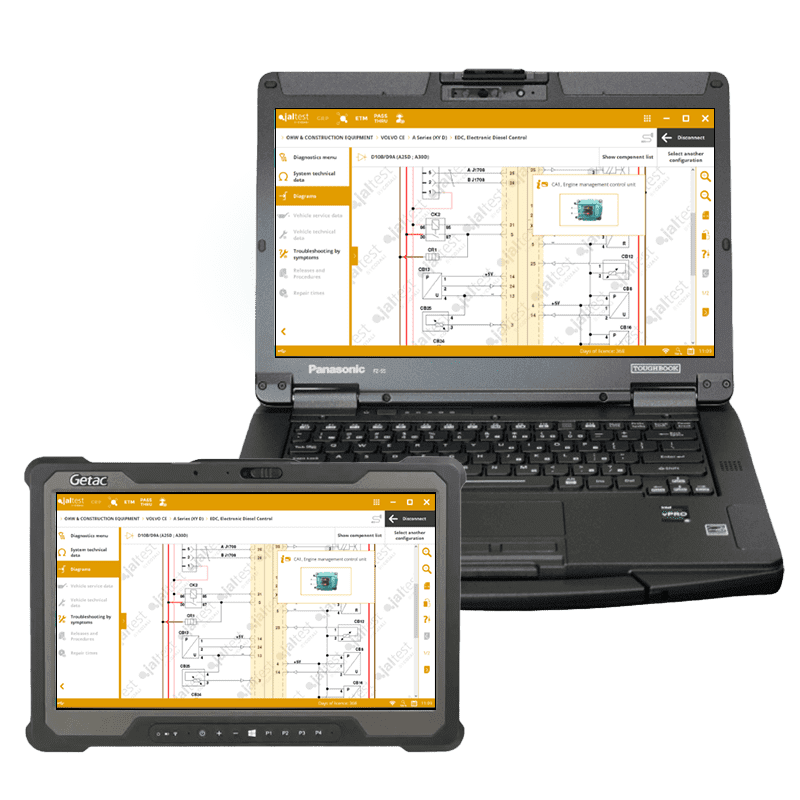
| Circuit Diagrams | Interactive circuit diagrams with parts and sensor location photos and graphics guide technicians to the right circuit, the right connection, and ultimately to the solution. It allows technicians to view color-coded diagrams on screen or printable diagrams to identify electrical issues and repair them successfully. |
| System Diagrams | Fuel, emissions, PTO and major components are hard to see on the equipment and even harder to understand without robust system diagrams with all components, connections and live values presented graphically to our techs. Your diagnostic software must include custom system diagrams that are exact representations of your equipment’s various components represented in colorful graphics that are easy to understand, and easy to identify potential issues with live value display |
| Technical Information | Torque specs, belt patterns, fan belt routing, valve angles, temperatures, amperage, voltage, pressures, and other service information are essential for successful diagnosis and repairs. |
| Training | Technicians need training on new equipment, components, and the navigation of diagnostic software. |
| Software updates | New machine coverage and diagnostic functions depend on active software updates. |
| Setup and support | The right cables, rugged hardware, onboarding, and technical support can make or break daily use. |
| Reliability Hardware | Shops or working on equipment in the field can present tough environments for your hardware. Durable, shock, temperature, drop resistant hardware is the foundation of your investment. Investing in ruggedized hardware is crucial to maximizing tool uptime. |
For shops and fleets with mixed heavy equipment, Jaltest Off-Highway is usually the best starting point. For teams that also handle commercial vehicle diagnostics that also work on specific brands such as Cummins off-highway engines, Caterpillar and John Deere equipment , an Autel MS909CV may fit as a secondary or crossover tool, depending on the equipment mix.
The short version: do not decide by brand name alone. Take all of these factors into consideration before making your investment.
What Is an Off-Highway Diagnostic Tool and Why Do You Need One?
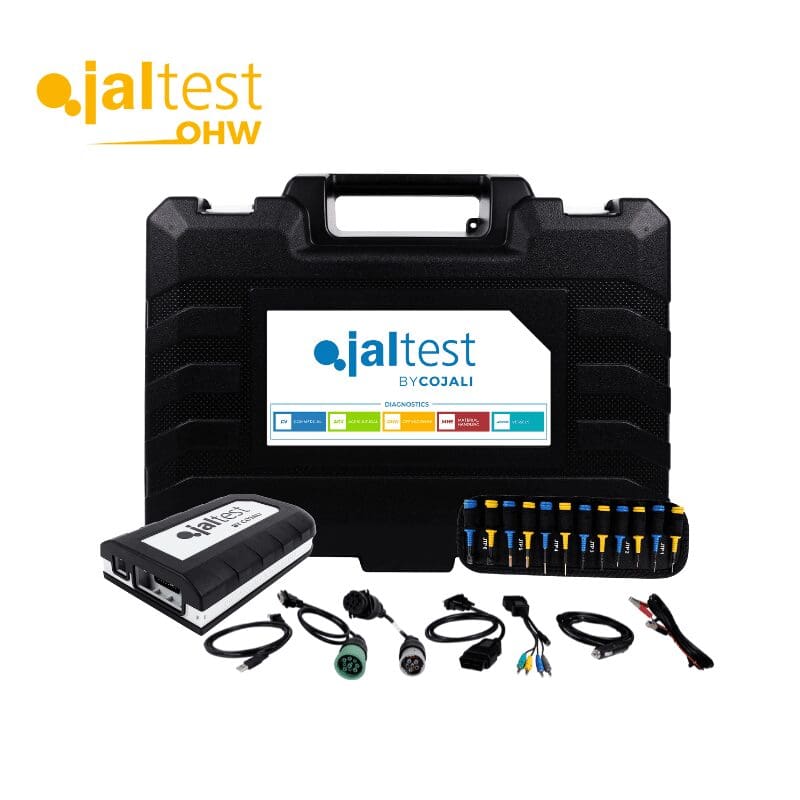
An off-highway diagnostic tool is a diagnostic platform built for heavy equipment used in construction, mining, municipalities, landfills, utility, industrial, and jobsite environments. It helps technicians connect to equipment control systems, read fault codes, view live data, run tests, perform calibrations, and verify repairs. Jaltest also includes robust troubleshooting and repair information with technical data, interactive circuit diagrams, system diagrams and more, all in one application that is fully integrated all within the software user interface.
A basic heavy equipment diagnostic scanner may help pull codes. A professional off-highway diagnostic platform helps technicians move from fault code to fix with all needed information to do so.
That difference matters when a machine is sitting on a jobsite with an operator waiting, a crew stalled, and a schedule slipping. Heavy equipment downtime gets expensive fast. The right tool helps reduce guesswork, speed up repair decisions, and keep more work in-house.
How off-highway diagnostics differs from on-road vehicle diagnostics
Off-highway diagnostics is different from automotive or commercial truck diagnostics because the machine systems are different.
In addition to engines, transmissions, instrument clusters, and body and chassis controllers, heavy equipment often adds more layers:
- Vehicle control systems
- Hydraulic systems
- Equipment controls
- Navigation systems
- Security systems
- Transmission and drivetrain systems
- Proprietary connectors
- Stationary diesel applications
- Engine and after treatment systems under heavy load conditions
What systems an OHW diagnostic tool covers
A professional off-highway diagnostic tool should go beyond fault code reading. Depending on machine coverage, technicians may need access to:
- Engine diagnostics
- Hydraulic diagnostics
- Transmission diagnostics
- Electrical system diagnostics
- DPF and aftertreatment functions
- Injector coding
- Cylinder cut-out tests
- Parameter changes
- Maintenance resets
- System calibrations
- Live data
- Bi-directional controls
- Wiring diagrams
- Technical specifications
- Guided troubleshooting
For a shop working on excavators, graders, loaders, cranes, backhoes, street sweepers, generator sets, and stationary diesel engines, this depth is what turns a tool into a daily repair asset.
Who needs off-highway diagnostic tools?
Off-highway diagnostic tools make sense for any operation responsible for keeping heavy equipment working.
That includes:
- Construction contractors
- Mining operations
- Heavy equipment repair shops
- Equipment rental fleets
- Landfill operations
- Municipal maintenance teams
- Industrial service operations
- Dealers and service providers
- Mixed fleets with trucks and off-road equipment
The pressure is different for each group, but the problem is the same: when machines are down, work slows and costs climb.
For rental fleets, downtime cuts utilization and adversely affects revenue. For contractors, downtime can delay the job and leave work crews waiting and worse, potentially miss crucial deadlines. For repair shops, lack of proper diagnostic capability can mean lost billable work or a comeback. For municipal teams, delays can affect public works schedules and cause more risk during times of emergency or time sensitive projects.
A full diagnostic tool for off-highway equipment that covers 99% of the brands of equipment and components that has dealer-level functionality is crucial.
Step-by-step guide on how to choose the right off-highway diagnostic tool for heavy equipment
Step 1: Define Your Machine Coverage Requirements
The first step is simple: list the equipment you service.
Not the equipment you might service one day. The machines that show up now. The ones that break at the worst time. The ones your team sends out because there is no available software to get deep enough into the system or perform the correct repair process to get the equipment back up and running.
Build a quick list by:
- Brand
- Model
- Year range
- Engine type
- Machine type
- Use case, often near a corporate shop or in the field in a far location
- Required diagnostic cables and accessories
- Systems your team needs to access
This keeps the buying process grounded. Product pages can sound impressive, but coverage only matters if it fits the machine in your bay or on your jobsite.
Single-brand vs. multi-brand fleets: what tool type do you need?
A single-brand fleet may still need an OEM tool for certain procedures. If every machine is from one manufacturer and your work is highly brand-specific, OEM software can make sense.
Most heavy equipment operations are not that tidy.
With almost 100 different brands of equipment and components available in the North American market, mixed fleets often include multiple brands like Caterpillar, Komatsu, Volvo CE, John Deere, Liebherr, JCB, Cummins-powered equipment, Deutz engines, Allison transmissions, Bosch Rexroth hydraulics and other manufacturers in the same operation. That is where a multi-brand platform becomes the better daily standard.
A multi-brand off-highway scan tool helps technicians work from one process instead of jumping between separate OEM programs, connectors, software, subscriptions, and logins.
Jaltest Off-Highway diagnostic solutions means OEM tools become the limited exception for brand-specific needs, while the Jaltest Off-Highway diagnostic platform handles more of the daily diagnostic work.
Key OHW brands to verify coverage
Before buying, verify coverage for the brands that matter most to your operation.
Common off-highway brands to check include:
- Caterpillar
- Komatsu
- Bobcat
- Volvo CE
- John Deere
- Liebherr
- JCB
- Cummins
- Deutz
- Case
- New Holland
- Doosan
- Hitachi
Coverage should be checked by model and function, not just brand.
Ask better questions:
- Does it cover this machine?
- Does it cover this controller?
- Does it support this test?
- Does it include the right cable?
- Does it provide repair information for this fault?
- Will my technicians know how to use it when the machine is down?
That last question gets skipped too often. It should not.
Step 2: Evaluate Diagnostic Depth by System
Once coverage is confirmed, look at depth.
A tool that connects is not always a tool that solves the problem. The best off-highway diagnostic tool should help technicians diagnose the systems that cause the most downtime.
Engine diagnostics: fault codes, live data, and injector tests
Engine diagnostics should include more than reading and clearing codes.
Look for support for:
- Active and stored fault codes
- Live data
- Sensor values
- Injector coding
- Cylinder cut-out tests
- DPF regenerations
- SCR and aftertreatment data
- Parameter resets
- Maintenance functions
This is where shops often confuse a heavy duty diesel scanner with a full off-highway diagnostic tool. Engine access is useful, but heavy equipment repair often needs more than engine access.
If the tool cannot help confirm the fault, the technician is still left making an educated guess. Sometimes the guess works. Sometimes it turns into a parts bill nobody enjoys explaining.
Hydraulics and transmission diagnostics on heavy equipment
Hydraulics are a major reason off-highway diagnostics needs its own tool strategy.
A loader that will not lift correctly, an excavator with weak response, or a grader with hydraulic faults may need system data, calibrations, pressure references, sensor readings, and component tests.
Transmission diagnostics can be just as important. Technicians may need access to shift data, solenoids, clutch values, speed sensors, calibration routines, and fault history.
A powerful off-highway diagnostic platform should help technicians see how the machine is behaving, not just what code was stored.
Electrical system and DPF diagnostics for off-highway machines
Electrical faults are where time goes to disappear.
A wiring issue, weak signal, sensor problem, connector fault, or communication failure can look like a failed component if the technician does not have enough data. Interactive wiring diagrams, component locations, system parameters, and live readings help shorten that hunt.
For diesel equipment, DPF and aftertreatment support is also critical. Forced regens, resets, SCR checks, injector functions, and emission-related tests can help technicians address derates and performance issues without waiting on dealer support.
The outcome is practical: fewer stalled repairs, fewer unnecessary parts, and fewer machines sitting while someone tries to track down the next step.
Step 3: Assess Software Update Frequency and Support
Heavy equipment changes. New models come in. Software coverage expands. Diagnostic functions improve. If the tool is not updated, its value starts sliding backward.
That is why software updates should be part of the buying decision, not a renewal reminder you notice after the tool stops helping.
Why regular software updates matter for new machine model coverage
Software updates can affect:
- New machine model coverage
- New system coverage
- Added diagnostic functions
- Updated troubleshooting information
- Improved calibration support
- Expanded brand coverage
- Software stability and usability
For shops that handle mixed equipment, updates are not optional housekeeping. They protect the tool’s usefulness.
A tool that is current helps technicians handle newer machines and changing systems. A tool that is outdated can leave the shop stuck on work it should be able to handle.
How to evaluate vendor support before buying
Support is part of the product.
Before choosing a heavy equipment diagnostic scanner, ask:
- Who helps with setup?
- Who confirms coverage before purchase?
- Who helps choose cables and adapters?
- Who trains technicians?
- Who handles software renewals?
- Who answers when a diagnostic function will not complete?
- Who helps when the tool is working, but the technician is still stuck?
This is where buying through Triad changes the experience. The value is not just access to Jaltest Off-Highway for true all makes coverage or Autel MS909CV for three specific popular brands, it is the practical help around the tool: matching the setup to the equipment list, getting the kit configured correctly, helping technicians learn the workflow, and staying available when the repair gets sideways.
That matters because a tool with no support is just a very expensive question mark.
Step 4: Compare Total Cost of Ownership
The cheapest tool is not always the least expensive one.
A low-cost scanner can be useful for quick checks, but if it misses systems, lacks bi-directional controls, requires extra purchases, or sends work back to the dealer, the savings disappear fast.
Total cost of ownership should include:
- Hardware
- Software license
- Updates
- Cable kits
- Adapters
- Rugged computer or tablet
- Training
- Support
- Connection times with multiple diagnostic applications
- Downtime from tool limitations
- Dealer visits and sublet repairs
- Technician time spent switching tools
The real cost is not what the scanner costs. It is what happens when the scanner cannot finish the job.
One multi-brand tool vs. multiple OEM scanners: cost breakdown
A multi-brand tool usually has the strongest case when the fleet or shop works across several equipment brands.
| Cost Area | Multiple OEM Tools | Multi-Brand Off-Highway Tool |
|---|---|---|
| Software | Separate programs and renewals | One primary platform |
| Training | Different workflow for each OEM | One repeatable process |
| Cables | Brand-specific adapters | Planned cable kit by equipment mix |
| Updates | Multiple renewal schedules | Centralized renewal process |
| Daily workflow | Tool switching and login friction | More consistent technician process |
| Best fit | Single-brand depth and special cases | Mixed fleets and daily diagnostics |
The goal is not to eliminate OEM tools completely. The goal is to stop making every routine diagnostic job depend on a pile of separate systems.
Subscription vs. one-time license models explained
Some diagnostic platforms use annual software licenses or renewals. Some tools may advertise one-time access or limited update periods.
Do not compare those models by price alone.
Ask what the license includes:
- Software updates
- Brand coverage expansion
- Technical support
- Repair information
- Wiring diagrams
- New functions
- Hotline or vendor assistance
- Renewal requirements
A cheaper tool with limited updates may look good on the invoice and weak in the shop six months later.
Off-Highway Diagnostic Tools Compared: Feature Checklist
Use this checklist when comparing Jaltest Off-Highway, Autel MS909CV, OEM tools, and basic scanners.
| Feature | Why It Matters | Jaltest Off-Highway | Autel MS909CV | OEM Tools | Basic Scanner |
|---|---|---|---|---|---|
| Multi-brand OHW coverage | Supports mixed equipment fleets | Strong | Select applications | Limited to brand | Limited |
| Engine diagnostics | Core fault and performance work | Yes | Yes on supported applications | Yes | Usually limited |
| Hydraulics diagnostics | Critical for heavy equipment | Strong | Varies | Strong for brand | Usually limited |
| Transmission diagnostics | Supports drivability and shift issues | Yes | Varies | Strong for brand | Limited |
| Electrical data and diagrams | Helps trace faults faster | Strong | Varies | Strong for brand | Limited |
| DPF and aftertreatment functions | Needed for diesel derates and regen issues | Yes | Yes on supported applications | Yes | Limited |
| Bi-directional controls | Lets techs test, command, and verify | Strong | Yes on supported applications | Strong for brand | Limited |
| Guided troubleshooting | Helps techs move from code to repair | Varies | Varies | Varies | Limited |
| Cable planning | Needed before the first connection | Kit-based | Adapter-based | Brand-specific | Limited |
| Best use case | Mixed heavy equipment diagnostics | Primary OHW tool | Crossover commercial and select OHW | Brand-specific procedures | Quick code checks |
How Jaltest OHW scores on each evaluation criterion
Jaltest Off-Highway is strongest when the operation needs broad machine coverage, system depth, guided repair information, and a repeatable diagnostic process across mixed equipment.
It fits best for:
- Construction fleets
- Mining operations
- Municipal maintenance teams
- Heavy equipment repair shops
- Rental fleets
- Mixed fleets with varied equipment brands
Its biggest advantage is workflow. Technicians can diagnose, test, calibrate, and access repair information from one platform instead of bouncing between multiple OEM tools.
The Triad advantage is in getting that platform set up correctly. Off-highway diagnostics depends on the right combination of software, cables, rugged hardware, updates, and training. Triad helps make sure those pieces fit the machines you work on before the tool is expected to earn its keep.
What Setup Makes Sense for Your Operation?
Different operations need different buying paths.
| Operation Type | Recommended Direction | Why |
|---|---|---|
| Construction contractor | Jaltest Off-Highway Build-A-Kit | Keeps mixed jobsite equipment moving with deeper diagnostic access. |
| Heavy equipment repair shop | Jaltest Off-Highway with cable planning | Covers varied brands and machine types coming through the shop. |
| Rental fleet | Multi-brand platform plus technician training | Helps reduce downtime and improve equipment utilization. |
| Municipal shop | Jaltest Off-Highway with setup and renewal support | Supports varied equipment with all-in-one consistent processes. |
| Shop that also works on trucks | Jaltest Off-Highway plus Jaltest Commercial Vehicle software | Supports heavy equipment diagnostics and commercial vehicle overlap. |
| Mostly one-brand fleet | OEM tool plus multi-brand support tool | Keeps OEM depth available while improving daily diagnostic flexibility. |
This is where a quick conversation can prevent a bad buy. A product page cannot see your equipment yard. A sales rep who asks the right questions can.
Common Buying Mistakes to Avoid
Buying based on price alone
A cheaper tool can become expensive fast if it lacks system access, repair information, cables, or support. Downtime usually costs more than the price gap between the wrong tool and the right one.
Assuming truck diagnostics covers heavy equipment
A heavy duty truck scan tool, commercial truck scanner, or heavy duty diesel truck diagnostic scanner may help with some systems, but off-highway machines bring hydraulics, machine controls, implement systems, and equipment-specific procedures.
A truck tool and an OHW tool are not the same thing.
Forgetting the cable kit
The software may support the machine. The technician still needs the right connector. Cable planning should happen before purchase, not after the first failed hookup. Unlike commercial trucks which only have three connector types, brand specific diagnostic connectors are the norm for off-highway equipment. Jaltest offers specific connector cables for each application covered, plus a multi-pin connector with specific connection instructions in the software allowing technicians to connect every time, even when the custom cable is not available.
Training only one technician
If only one person knows how to use the tool, the shop has a bottleneck. Train the people who touch diagnostics daily, not just the person with the most patience for software. Jaltest offers a single user interface, navigation paths, and nomenclature making it much easier to train technicians on utilization and throughput of the shop.
Ignoring renewals until the tool stops helping
Software renewals keep coverage and support current. Assign ownership early so updates do not become another thing everyone thought someone else handled.
Why Jaltest Off-Highway Software Renewal Matters
Off-highway equipment does not sit still, and neither should your diagnostic software. New machines, updated controllers, added service functions, and expanded repair information can all affect whether your technician can finish the job without calling the dealer.
With an active Jaltest Off-Highway license, your team keeps access to the updates and technical data that support daily diagnostics on construction, mining, municipal, and industrial equipment.
That includes:
- Software updates: Coverage and functions can expand as new machine models, systems, and capabilities are added.
- Repair information: Technicians can access key technical data, including wiring diagrams, component locations, troubleshooting, maintenance procedures, and system specifications.
- Update and platform support: Your team has a support path for software update questions, Windows-related issues, and Jaltest platform concerns.
For off-highway shops, this matters because downtime hits hard. A machine waiting on diagnostics can hold up a crew, delay a job, or force a rental decision nobody wanted to make.
Triad helps keep the renewal side practical. We can help confirm the right Jaltest Off-Highway license, support the update process, and make sure your tool stays matched to the machines your team actually services.
Frequently Asked Questions: Off-Highway Diagnostic Tools
Do it before the license expires. Waiting until a machine is down is the worst time to find out the software is not current. Triad actively manages the timeline for your renewals and will contact you in plenty of time to ensure renewals are in place well before your software expires.
Yes. Triad can help with renewal guidance, software update support, and setup questions so the tool stays ready for field or shop use.
Heavy equipment coverage changes as new models, controllers, and service functions are added. Renewal helps keep the tool useful for current machines instead of leaving technicians working with outdated coverage.
A Jaltest Off-Highway renewal keeps the software current with available updates and supports continued access to technical information tied to the active license.
Off-highway diagnostic software should be kept current through active updates and renewals. Updates help maintain coverage for newer machines, new systems, added functions, and updated repair information. Shops should assign someone to manage renewals so diagnostic coverage does not fall behind.
For mixed construction equipment fleets, Jaltest Off-Highway is a strong choice because it supports multi-brand diagnostics, live data, bi-directional controls, guided troubleshooting, wiring diagrams, calibrations, and repair information. Autel MS909CV can also fit shops that need commercial vehicle diagnostics for smaller fleets or fast repairs with select off-highway coverage included in the tool for Cummins off-highway engines, Caterpillar and John Deere equipment.
Off-highway diagnostics focuses on heavy equipment systems such as hydraulics, transmissions, machine controls, diesel engines, electrical networks, and aftertreatment systems. Automotive diagnostics focuses on passenger vehicles and light-duty systems. Heavy equipment usually requires different software, connectors, procedures, and system access.
Yes. Multi-brand platforms like Jaltest Off-Highway are designed to support many heavy equipment brands from one diagnostic workflow. Coverage still depends on the machine, model, system, software license, and cables. Always verify coverage against your actual equipment list before buying.
An off-highway diagnostic tool connects to heavy equipment control systems to read fault codes, view live data, run tests, perform calibrations, reset maintenance functions, and support repair verification. Professional tools also provide guided troubleshooting, wiring diagrams, technical specifications, and repair information for supported machines.
Choose the Tool Around the Machines That Cost You the Most
The right off-highway diagnostic setup should help your team turn stalled repairs into billable, finished work faster.
With Jaltest Off-Highway, technicians can move from fault code to live data, system tests, repair information, calibration steps, and documentation in one workflow. That means fewer hours lost jumping between tools, fewer unnecessary parts ordered on a guess, and fewer machines waiting on dealer availability while crews, operators, or customers lose time.
Buying through Triad helps protect that return. Your team gets the kit matched to the machines you service, the cables needed to connect, the rugged hardware to hold up in the shop or field, and the training and support to keep technicians moving when a repair gets complicated. Triad is also a Platinum Value Added Reseller for Panasonic TOUGHBOOKS and Getac ruggedized laptops and tablets ensuring this crucial equipment has the best performance and opportunity for tool uptime in the industry.
The outcome is simple: faster repair decisions, more work kept in-house, better technician confidence, and less revenue lost to downtime.
If Jaltest Off-Highway fits your equipment mix, start with the build-a-kit and confirm the right cable package. If you are comparing Jaltest Off-Highway, Autel MS909CV, OEM tools, or a heavy equipment diagnostic scanner, bring Triad your equipment list and the jobs that keep slowing your team down.
Explore Off-Highway Diagnostic Kits or get help matching the right setup to your equipment list.