
Automotive A/C Diagnostic Tool vs. Recovery Machine: Why Shops Need Both
A technician can recover the correct amount of refrigerant, evacuate the system, recharge it to specification, and still have a vehicle blowing warm air.
The refrigerant service was completed. The A/C problem is still sitting in the bay.
That is the difference between refrigerant service and HVAC diagnosis.
A recovery, recycling, and recharge machine handles the refrigerant side of the job. An automotive A/C diagnostic tool helps your technician figure out why the system is not working correctly by looking deeper into pressures, temperatures, electronic controls, compressor operation, airflow, moisture, leaks, and vehicle data.
For shops already running a Robinair, Bosch, TEXA, or another A/C service machine, that distinction matters. The equipment you already own still has an important job. A system such as the Autel MaxiHVAC AC909 gives it a diagnostic partner.
Key Takeaways
- Your refrigerant recovery machine handles recovery, recycling, evacuation, and recharge.
- An automotive A/C diagnostic tool helps identify what is causing poor HVAC performance.
- The Autel AC909 combines physical pressures and temperatures with supported vehicle OBD data in the same diagnostic workflow.
- Variable-displacement compressors, electronic valves, multi-zone HVAC, hybrids, EVs, and heat pumps create diagnostic problems that require more information than refrigerant quantity alone.
- A stronger A/C workflow starts with diagnosis and ends by verifying that the repair actually solved the problem.
Table Of Contents
Why A/C Recovery Machines and Diagnostic Tools Do Different Jobs
A conventional recover, recycle, and recharge machine is very good at the work it was built to perform.
It can help answer questions such as:
- How much refrigerant was recovered?
- Can the system be evacuated?
- Can it be recharged to the specified amount?
- Is the refrigerant contaminated when the machine includes identification capability?
- Can the service cycle be completed automatically?
Take the Robinair AC1234-4 as an example. Robinair specifies 98.5% recovery efficiency and charge accuracy within ±0.5 oz, along with automated recovery, vacuum operation, refrigerant identification, oil drain, and recharge functions. (Robinair)
Bosch describes its ACS 563 around the same core service job: refrigerant recovery, recycling, vacuum testing, and refrigerant recharge. Bosch lists recovery performance of up to 95% for that system. (Mobility Aftermarket)
Those are valuable capabilities.
Then comes the vehicle that has the correct refrigerant charge and still refuses to cool properly.
Now the technician needs a different set of answers:
- Is the compressor producing the pressure change it should?
- Is an electronically controlled variable-displacement compressor responding correctly?
- Do the physical pressures and temperatures agree with what the vehicle modules are reporting?
- Is there a restriction or heat-transfer problem?
- Is excessive moisture still present?
- Is the system tight?
- Are blend doors and supported electronic HVAC controls responding correctly?
- Does the evidence point toward a mechanical, refrigerant-related, or electronic problem?
That is the diagnostic gap the AC909 is designed to address.
What an Automotive A/C Diagnostic Tool Adds
Pressure gauges tell part of the story. Modern vehicle data tells another part.
The Autel MaxiHVAC AC909 brings those pieces together by combining actual HVAC pressures and temperatures with supported OBD sensor values and commands on a single diagnostic screen. Autel specifically highlights blend-door functionality, outlet temperature readings, variable-displacement compressor testing, nitrogen pressure testing, guided procedures, and equipment self-diagnostics among the AC909’s capabilities.
That changes the conversation in the bay.
Instead of seeing an unusual pressure reading and immediately moving toward a refrigerant adjustment or component replacement, the technician can compare what the vehicle is commanding with what the refrigerant circuit is physically doing.
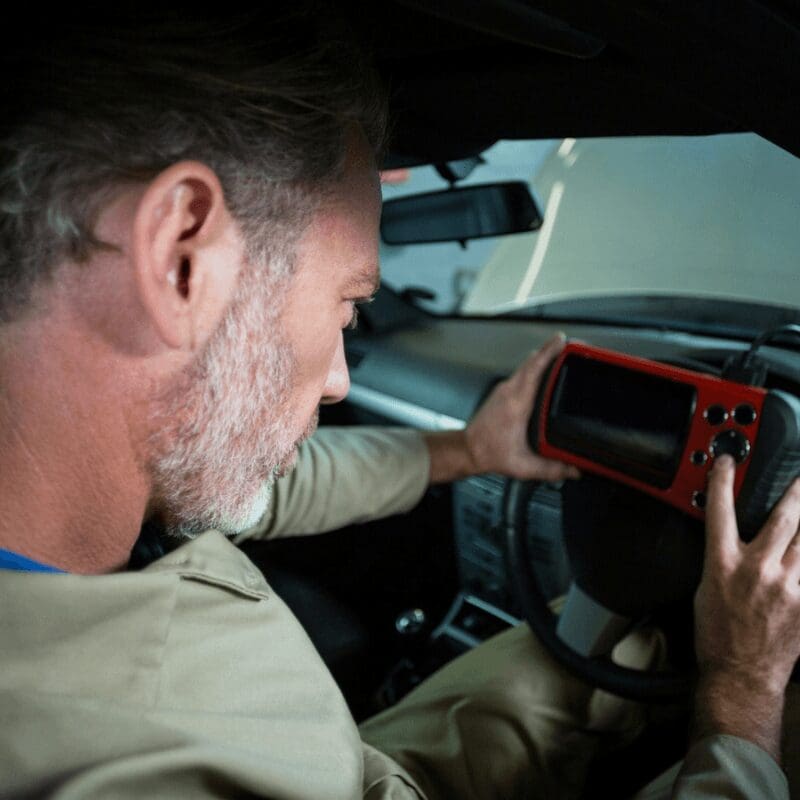
For example, the vehicle may be commanding a compressor response. The AC909 gives the technician a way to evaluate that command alongside actual high-side and low-side behavior. Autel also supports variable-displacement compressor testing through supported OBD bidirectional commands and/or a physical ECV connection while monitoring pressure response.
The same approach carries across the rest of the HVAC system.
| AC909 Capability | What It Means in the Bay |
|---|---|
| Graphical diagnostics and sensor fusion | Compare physical pressures and temperatures with supported OBD data in one workflow |
| 4-port manifold system | Gives technicians a dedicated platform for advanced HVAC testing |
| Wireless pressure monitoring | Allows pressure data to remain available through supported wireless workflows |
| OBD data integration | Compare vehicle commands and sensor values with physical refrigerant-system behavior |
| Bidirectional HVAC controls | Command supported HVAC components and evaluate system response |
| Variable-displacement compressor testing | Evaluate compressor operation while monitoring pressure response |
| Superheat and subcooling analysis | Add system-performance information beyond basic pressure readings |
| Nitrogen pressure testing | Evaluate system tightness and support leak diagnosis |
| Nitrogen purge procedures | Support moisture-removal and evacuation workflows |
| Micron-level vacuum measurement | Evaluate vacuum at a finer level than conventional inches-Hg readings |
| Large backlit sight glass | Inspect refrigerant for excessive dye, oil contamination, heat-related evidence, and particles |
| Guided repair workflow | Walk technicians through equipment hookup and testing procedures |
| Vehicle-specific HVAC information | Access supported specifications and component information |
| Equipment self-diagnostics | Check manifold accuracy, system tightness, and equipment performance before relying on test results |
The supplied AC909D configuration also includes a dual-stage 6 CFM NAVAC vacuum pump rated to a 15-micron ultimate vacuum, along with Bluetooth measurement equipment designed to bring live system data into the diagnostic workflow.
Already Own a Robinair, Bosch, TEXA or Other A/C Machine? Keep It.
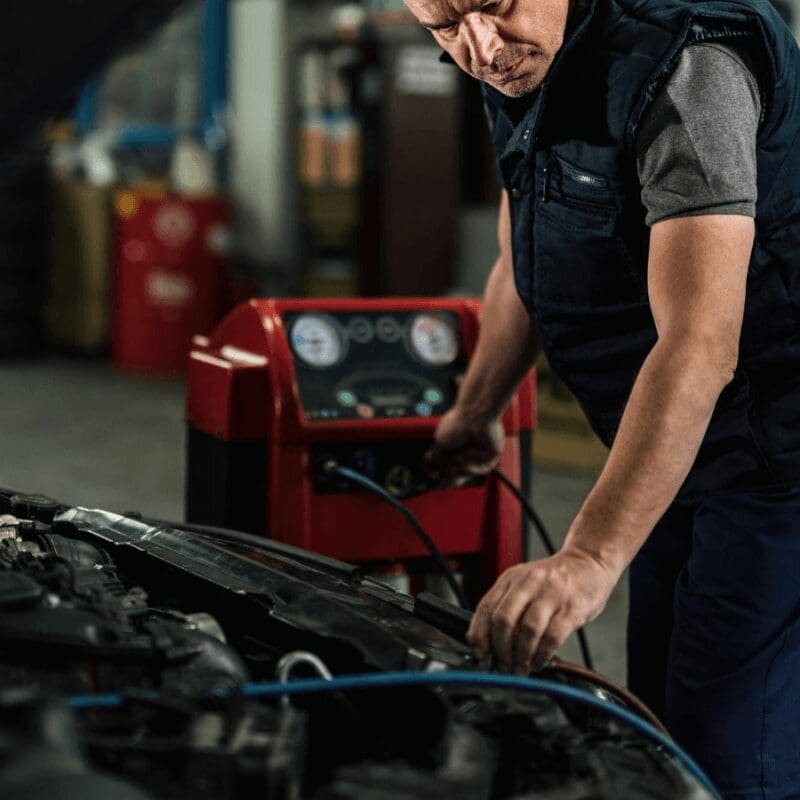
A shop that already invested thousands of dollars in a good refrigerant machine has useful equipment sitting in the bay.
Keep using it.
The AC909 serves a different part of the repair process.
Your RRR machine handles refrigerant recovery, recycling, evacuation, and recharge. The AC909 helps your technician diagnose the system before that work, determine the likely repair path, and evaluate HVAC performance after the repair.
That makes the systems complementary.
Think of it this way:
Your recycler handles the refrigerant. The AC909 helps your technician figure out why the A/C system is not working correctly.
For a shop owner, that distinction matters because the expensive problem is rarely the few minutes spent connecting a machine. The expensive problem is a bay tied up while a technician chases the wrong cause, replaces a component that does not solve the complaint, or gets the vehicle back after the customer discovers the air is still warm.
Triad’s broader automotive approach follows the same idea. Diagnostic equipment should help technicians move toward the repair path faster, reduce parts swapping, and keep more capable work inside the shop.
How the AC909 Fits Into Your Existing A/C Repair Workflow
This six-step workflow shows exactly where an automotive HVAC diagnostic tool fits.
1. Diagnose with the AC909
Connect to the vehicle and evaluate HVAC faults, supported electronic controls, pressure, temperature, compressor operation, and overall system performance.
2. Identify the repair path
Use the combined data to determine whether the problem points toward refrigerant charge, leakage, moisture, compressor control, airflow, a restriction, an electronic component, or another HVAC issue.
3. Recover refrigerant with the existing RRR machine when required
Your Robinair, Bosch, TEXA, or other appropriate refrigerant machine continues doing the work it was purchased to perform.
4. Repair and evacuate the system
The AC909 adds nitrogen testing, purge procedures, and micron-level vacuum measurement to help technicians evaluate system integrity and moisture removal.
5. Recharge with the existing RRR machine
Use the recycler/recharger to deliver the specified refrigerant charge.
6. Verify the repair with the AC909
Reconnect the diagnostic workflow and compare pressures, temperatures, supported electronic commands, and actual HVAC performance.
That sixth step carries a lot of weight.
Recovering, evacuating, and recharging tells you the refrigerant service was completed. Diagnostic verification gives the technician additional information to evaluate whether the repair addressed the original problem.
Why Modern HVAC Systems Need More Diagnostic Data
Automotive A/C used to be easier to separate from the rest of the vehicle.
That line keeps getting thinner.
Modern systems can include electronically controlled variable-displacement compressors, multiple valves, blend doors, multi-zone climate control, sensors, vehicle modules, advanced heat pumps, and thermal-management functions tied to hybrid and EV operation.
Autel describes the AC909 around exactly that change. Its current product information positions the system for electronically controlled compressors and advanced heat pumps, while combining direct HVAC measurements with electronic vehicle data.
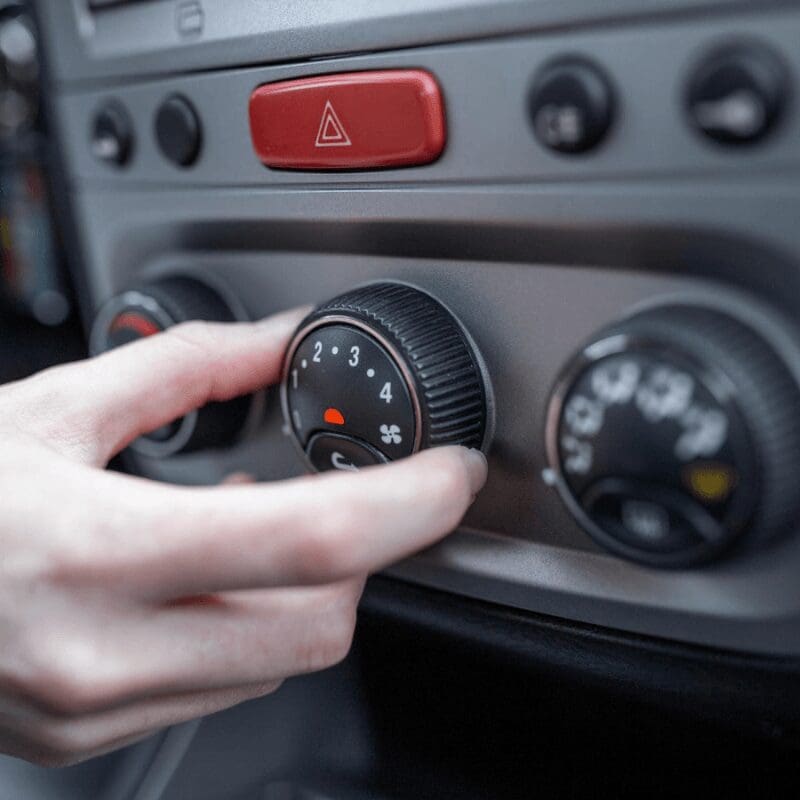
That matters because one symptom can have several possible causes.
Poor cooling could point toward the refrigerant circuit. It could involve compressor control. It could involve airflow. It could involve a sensor, blend door, restriction, heat-transfer problem, excessive moisture, or another supported HVAC component.
A technician needs enough information to separate those possibilities before the parts cannon gets loaded.
For shops servicing hybrids and EVs, that diagnostic depth becomes even more useful. Thermal management has a larger role across those vehicles, and the AC909 is designed to support modern HVAC and heat-pump diagnostic workflows where vehicle coverage and functions are supported.
What This Means for the Shop
The strongest reason to add an automotive A/C diagnostic tool is not the length of the feature list.
It is what happens when a difficult A/C job enters the bay.
A technician gets more information before deciding what to repair. The existing refrigerant machine stays useful. The workflow gives the team a defined path from initial diagnosis through refrigerant service and final verification.
For the shop owner or service manager, that can support the things that matter every day: repair accuracy, bay throughput, technician confidence, fewer unnecessary parts decisions, and the ability to handle more advanced HVAC work in-house.
The AC909 is the product. Triad helps make sure the product fits the work your technicians actually perform.
Triad supports automotive shops with Autel diagnostic platforms, setup guidance, technician training, workflow optimization, and live support when the job gets complicated.
Frequently Asked Questions About Automotive A/C Diagnostics
The AC909 is designed around modern thermal-management systems, including electronically controlled compressors and advanced heat pumps used across modern vehicle applications. Confirm vehicle-specific and function-specific coverage for the vehicle being serviced.
Yes. The AC909 supports nitrogen pressure testing for system-tightness checks and nitrogen purge procedures used during the diagnostic and evacuation process.
Yes. Autel states that the AC909 supports variable-displacement compressor testing through OBD bidirectional commands and/or a physical connection to the ECV valve while comparing live high- and low-side pressures.
Autel’s Graphic Diagnostic Diagram brings actual HVAC pressures and temperatures together with supported data from vehicle modules on one screen. This helps technicians compare electronic commands and sensor information with how the A/C system is physically responding.
The AC909 is an automotive HVAC diagnostic system that combines physical A/C pressures and temperatures with supported vehicle OBD data, guided testing, compressor diagnostics, nitrogen testing, vacuum measurement, and other thermal-management diagnostic functions.
Yes. Autel positions the AC909 for modern thermal-management systems, including electronically controlled compressors, advanced heat pumps, hybrids, and EV applications. Confirm vehicle-specific function coverage before service.
Yes. Autel lists nitrogen pressure testing for system tightness along with nitrogen purge procedures as part of the AC909 workflow.
Yes. The existing refrigerant machine continues handling refrigerant service while the AC909 supports diagnosis and repair verification.
An automotive A/C diagnostic tool helps technicians evaluate why an HVAC system is underperforming by analyzing pressures, temperatures, electronic vehicle data, compressor behavior, leaks, moisture, controls, and other supported system information.
No. Use appropriate RRR equipment for refrigerant recovery, recycling, evacuation, and recharge. The AC909 complements that equipment with HVAC diagnosis, system testing, and post-repair verification.