
ADAS Calibration Tools for Lane Departure Systems: In-Shop vs. Mobile [2026]
TL;DR: The best ADAS calibration tool for lane departure systems depends on your workflow. A dedicated in-shop operation may prioritize repeatable positioning and a controlled calibration area. A mobile technician needs equipment that can move between locations without sacrificing setup accuracy. Shops that need both should look for a system designed to bridge those workflows.
For lane departure work specifically, the decision comes down to OEM coverage, calibration space, positioning accuracy, portability, setup time, and how well the equipment integrates with your diagnostic platform.
ADAS Calibration for Lane Departure Systems Key Takeaways
- Lane departure calibration may be required after windshield replacement, camera replacement, collision repair, chassis work, ride-height changes, and other procedures identified by the vehicle manufacturer.
- Static and dynamic calibration describe how the vehicle is calibrated. In-shop and mobile describe where the work is performed.
- Your ADAS equipment needs to support the vehicles you service while giving technicians an accurate, repeatable way to complete the required OEM procedure.
- For shops that need both in-shop and occasional mobile capability, systems such as the Autel IA700LDWT combine optical positioning with a modular frame design and integrated diagnostic platform.
What Is Lane Departure System Calibration and When Is It Required?
Lane Departure Warning, or LDW, typically relies on a forward-facing camera to monitor lane markings and determine the vehicle’s position on the road. Related systems such as Lane Keeping Assist may use that same camera data to provide warnings or steering assistance when the vehicle begins leaving its lane. Calibration establishes the correct relationship between the camera and the vehicle so the system can interpret the road from the position specified by the manufacturer.
How Lane Departure Warning and Lane Keep Assist Systems Work
The forward-facing camera is typically mounted near the top of the windshield, where it monitors lane markings and other road information used by Lane Departure Warning and Lane Keeping Assist systems.
Because these systems rely on the camera’s position and viewing angle to interpret the vehicle’s location within the lane, even a small change in camera alignment can affect how the system reads the road. Calibration restores the camera to the vehicle manufacturer’s specified reference so the system can operate as intended.
For repair shops, that means replacing a windshield, servicing the camera, or completing certain collision repairs may add another required step to the repair plan: ADAS calibration
When Lane Departure Calibration Is Required
There is no universal trigger that applies to every vehicle. The OEM repair procedure determines when calibration is required.
Common situations that may require LDW calibration include:
- Repairing or replacing the forward-facing camera
- Repairing or replacing the windshield
- Chassis adjustments
- Changes to vehicle body height
- Relearning vehicle height through a height sensor
- Collision repairs that affect the camera, suspension, alignment, or vehicle geometry
The repair itself determines what needs to be checked. Technicians should confirm the current procedure for the specific year, make, model, and ADAS system before assuming calibration is or is not required.
OEM Calibration Specifications Drive the Procedure
Your ADAS frame does not decide how the vehicle should be calibrated. The manufacturer does. One vehicle may require a static calibration with a target positioned at an exact height and distance. Another may require a dynamic road procedure. Some vehicles require both.
That distinction matters when you are choosing equipment. A shop needs a calibration system that covers the vehicles coming through the door and gives technicians the tools, targets, software, and positioning capability required to follow those procedures correctly.
In-Shop ADAS Calibration for Lane Departure Systems
For shops with consistent ADAS volume, bringing lane departure calibration in-house gives you more control over scheduling and repair flow. A vehicle can move from windshield replacement, collision repair, alignment, or related service directly into calibration instead of waiting on an outside provider. The key is building the calibration process around the space and work your shop actually has.
Bay Space Requirements for Static Lane Departure Calibration
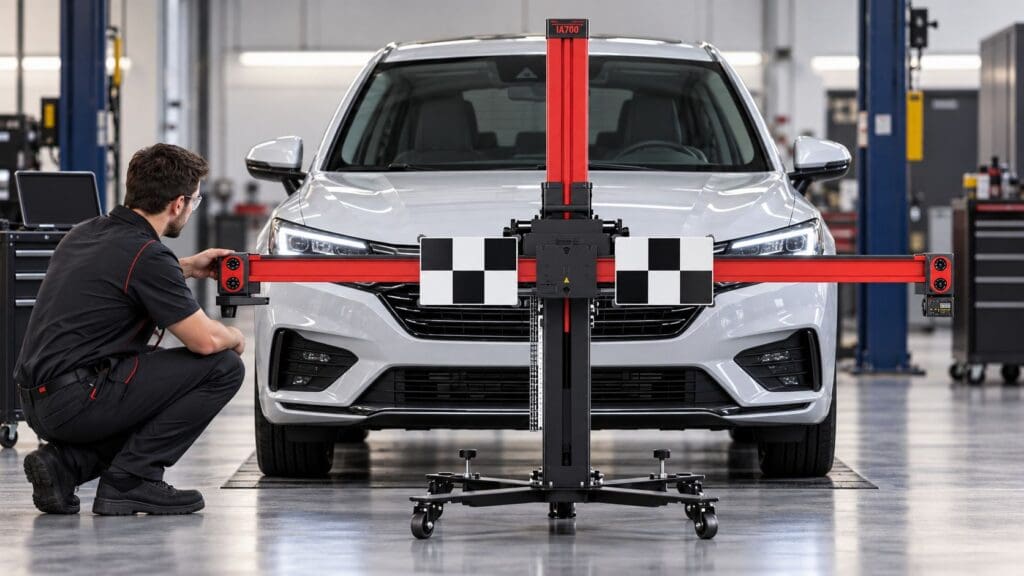
Static LDW calibration requires enough room to position the vehicle and target according to the OEM procedure. Floor condition, lighting, vehicle preparation, target clearance, and the working area around the vehicle can all affect the setup.
The frame fitting inside the bay is only one part of the equation. Technicians also need enough usable space to position targets correctly and complete the calibration without interfering with surrounding equipment or other repair work.
If ADAS calibration becomes a regular service, think about the bay as a working calibration area rather than simply a place to store the frame.
Target Placement and Alignment for Accurate Lane Departure Calibration
Target positioning can have a significant impact on both calibration accuracy and setup time.
Some systems rely heavily on manual measurements to establish the relationship between the vehicle and calibration frame. Optical systems use cameras and wheel-mounted targets to determine vehicle position digitally and guide the technician through target placement.
Every measurement, repositioning step, or setup problem adds time before the calibration itself begins. Equipment that helps technicians establish the correct position efficiently can make ADAS work easier to repeat across multiple vehicles.
Best In-Shop ADAS Tools for Lane Departure: Feature Checklist
When comparing ADAS calibration equipment for in-shop LDW work, look for:
- Coverage that matches the makes and models you regularly service
- OEM-guided calibration procedures
- Accurate vehicle-to-target positioning
- Alignment verification or pre-check capability
- Support for the floor and workspace conditions in your facility
- An LDW target package suited to your vehicle mix
- Pre-scan, calibration, post-scan, and reporting capabilities within the workflow
- An upgrade path into radar, blind spot, around-view, and other ADAS systems if you plan to expand
The best system is one your technicians can use consistently within the space, repair mix, and volume your shop already has.
Mobile ADAS Calibration for Lane Departure Systems
Mobile ADAS calibration takes the calibration equipment to the vehicle, allowing shops and service providers to perform work at collision centers, glass shops, dealerships, or other repair locations.
The opportunity is significant, especially when customers would rather keep the vehicle within their existing repair process. The tradeoff is that the technician has less control over the environment than they would in a dedicated calibration bay.
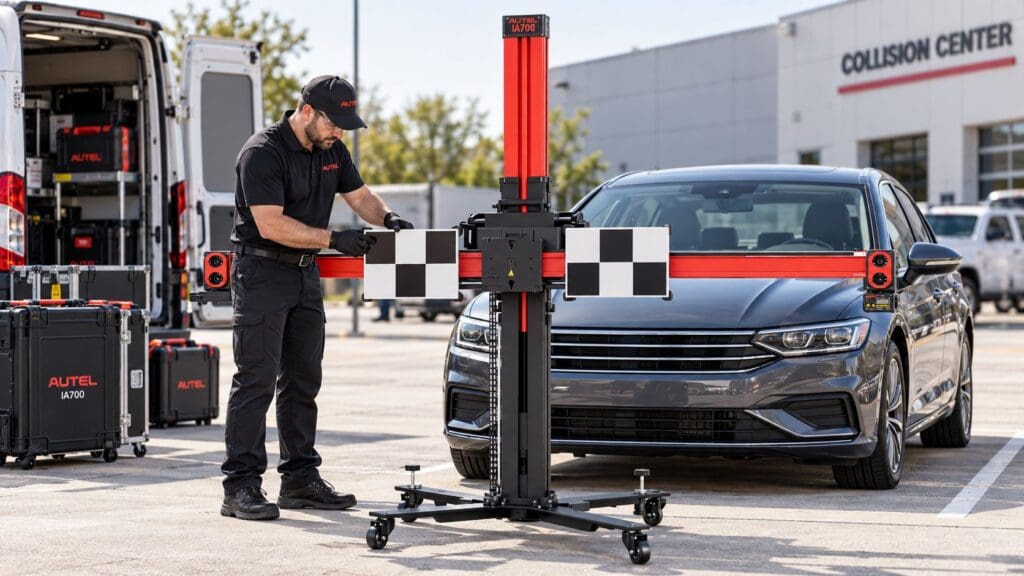
Mobile lane departure calibration brings the required ADAS equipment to the vehicle instead of requiring the vehicle to come to a dedicated calibration bay. The technician sets up the frame, positions the appropriate LDW target according to the OEM procedure, connects the diagnostic tablet and vehicle interface, and completes the required calibration at the service location.
Because that process has to be repeated from one location to the next, mobile ADAS equipment needs to balance portability with setup accuracy. A system that travels easily still needs to give technicians a repeatable way to establish the vehicle and target position when it is set back up.
Portable systems may use mechanical measurements, lasers, wheel clamps, camera-based positioning, or a combination of technologies. The right approach depends on how much equipment your technicians can transport, how frequently the system moves, and the types of locations where the work will be performed.
Vehicle and Workspace Considerations for Mobile Lane Departure Calibration
Mobile service still has to meet the requirements of the vehicle-specific calibration procedure.
For static calibrations, the technician may need to evaluate available space, floor condition, lighting, target clearance, and vehicle positioning before beginning the job. Dynamic calibrations bring their own requirements, including suitable road and driving conditions.
That makes job qualification especially important for mobile operations. Before dispatching a technician, you need to know whether the vehicle is covered, which procedure it requires, what targets or equipment are needed, and whether the service location can support the calibration.
Best Mobile ADAS Tools for Lane Departure: What to Look For
For mobile LDW work, prioritize equipment that gives your technicians:
- Practical transport and storage: The frame and targets need to fit the way your mobile operation is set up.
- Repeatable assembly: Moving between locations should not require rebuilding the calibration process from scratch.
- Accurate target positioning: Technicians need a consistent setup even when the work environment changes.
- Support for variable working conditions: Features that help account for floor or positioning differences can make mobile setup more practical.
- Strong LDW coverage: Your target package and software should match the vehicles driving your service volume.
- Guided calibration procedures: The technician needs the required procedure at the point of service.
- Integrated diagnostics and reporting: Pre-scan, calibration, post-scan, and documentation should fit together without unnecessary handoffs.
For mobile ADAS work, portability earns its value when technicians can move the equipment, rebuild the setup efficiently, and produce a repeatable calibration workflow at the next location.
IA700LDWT: Portable Lane Departure Calibration With Optical Positioning
For shops that want an optical ADAS system without permanently committing the equipment to one bay, the Autel IA700 Portable ADAS Frame + LDW + MS909 S2 Tablet fills the space between a traditional fixed setup and a more basic portable frame.
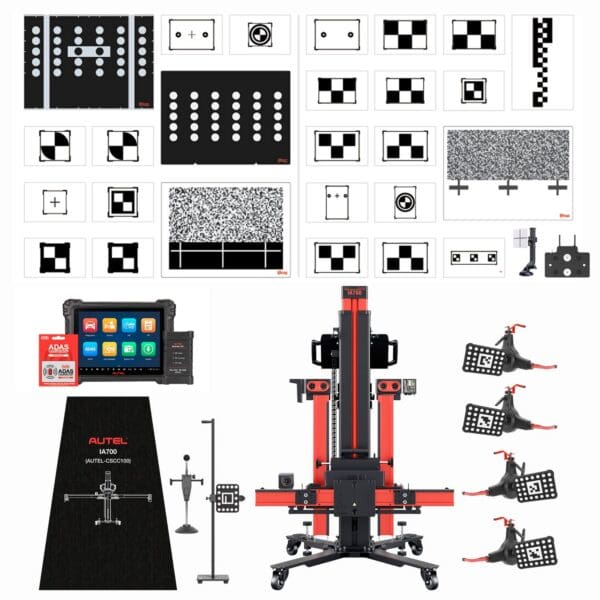
The IA700LDWT combines the IA700 calibration frame, optical vehicle positioning, wheel alignment pre-check, LDW calibration targets, and the MaxiSYS MS909 S2 diagnostic tablet in one package.
That configuration works well for collision centers, glass companies, multi-bay shops, multi-location businesses, and ADAS providers that need equipment capable of staying productive in the shop while still being practical to move.
In-Shop and Mobile Capabilities of the IA700LDWT
The IA700 uses six high-definition cameras and wheel-clamp targets to establish the relationship between the vehicle and calibration equipment. Its optical positioning system reduces the manual measuring involved in setup, while an integrated alignment pre-check can identify alignment conditions that need attention before calibration begins.
Unlevel-floor compensation adds flexibility when technicians are working in bays or service locations where the floor is not perfectly level.
When the system needs to move, the frame disassembles into five primary sections in less than 90 seconds for transportation or storage. That allows the same platform to serve as an in-shop system, move between bays, or support a mobile calibration operation.
Vehicle Coverage for Lane Departure Calibration
The IA700LDWT supports lane departure calibration across a broad range of U.S., Asian, and European vehicle applications.
The included LDW package provides the starting target set for lane departure work, while Autel’s vehicle-specific software guides technicians through the applicable procedure. Shops can use Triad’s ADAS Coverage Tool to confirm coverage and target requirements for unfamiliar applications before purchasing equipment or scheduling a calibration.
The platform can also expand beyond LDW as your ADAS service mix grows, allowing shops to add additional target packages rather than replacing the core frame.
Setup Time, Target Accuracy, and Software Integration
The IA700’s optical system is designed to reduce target-positioning time by up to 6X compared with mechanical measurement methods, with positioning accuracy rated at 0.02 degrees.
The robotic crossbar automatically adjusts target height, while digital guidance helps technicians confirm positioning before advancing through the calibration procedure.
The included MaxiSYS MS909 S2 keeps vehicle identification, diagnostics, ADAS procedures, calibration, and post-calibration verification within the Autel environment.
That integration has a practical shop impact. Calibration throughput depends on more than the time the vehicle spends performing the actual procedure. Setup, measurement, diagnostics, target placement, and verification all consume bay and technician time. Streamlining those steps can make a meaningful difference as calibration volume increases.
In-Shop vs. Mobile: Which Lane Departure Calibration Approach Fits Your Shop?
| Consideration | Dedicated In-Shop Calibration | Mobile / Portable Calibration |
|---|---|---|
| Best fit | Shops with consistent calibration volume at one location | Glass companies, mobile providers, multi-location and multi-bay operations |
| Workspace | Controlled calibration area that can be prepared in advance | Workspace must be evaluated at each service location |
| Setup consistency | Same environment can be used repeatedly | Equipment and process need to remain repeatable as locations change |
| Equipment movement | Frame can remain assembled and ready | Fast breakdown, storage, and transport matter |
| Workflow control | Greater control over floor, lighting, space, and scheduling | Technician works within the conditions available at the service location |
| Growth opportunity | Supports a dedicated in-house ADAS operation | Supports a wider service area and multiple repair locations |
Choosing Based on Repair Volume, Bay Availability, and Customer Type
Start with the calibration work already moving through or leaving your business.
A collision center regularly subletting post-repair calibrations may gain more control over cycle time by creating a dedicated in-house process. A glass company serving several locations may place more value on equipment that can travel with the windshield work.
General repair shops and multi-location businesses often fall somewhere between those two models. You may perform most calibrations at one facility today while still needing to move equipment between bays, reclaim floor space when necessary, or support another location as demand grows.
Then look ahead. If you expect LDW calibration to become the entry point into a larger ADAS service line, consider whether the platform can expand with you rather than forcing another major equipment purchase later.
Choose ADAS Calibration Equipment Around the Work You Want to Keep In-House
If lane departure calibrations are regularly leaving your shop after windshield replacement, collision repair, alignment, or related work, look at what that is costing you in cycle time, scheduling control, and outsourced revenue.
Then build the equipment decision around your actual workflow.
For a dedicated in-shop operation, that may mean prioritizing a controlled calibration area and fast, repeatable positioning. For mobile or multi-location service, portability and setup consistency become more important. If your operation needs both, the equipment needs to move without turning every relocation into a new setup problem.
The Autel IA700LDWT gives shops a flexible path into LDW calibration with optical positioning, alignment pre-check, portable construction, guided procedures, and the MS909 S2 diagnostic platform. The system can also expand as your ADAS service mix grows.
Triad can help you verify vehicle coverage, determine which targets and configuration fit your operation, and support your team with setup and training after the equipment arrives.
Explore the Autel IA700LDWT or talk with a Triad ADAS specialistTriad ADAS specialist about the right calibration setup for your shop.
Frequently Asked Questions About Lane Departure System ADAS Calibration
There is no single calibration time. Vehicle preparation, alignment condition, target setup, the required static or dynamic procedure, and post-calibration verification can all affect the total job. Faster positioning and setup can reduce the time surrounding the calibration itself.
Calibration requirements depend on the vehicle. Many vehicles require recalibration after windshield replacement or forward-facing camera removal, while others follow different procedures. Check current service information for the specific year, make, model, and ADAS system.
Yes, when the vehicle uses a dynamic calibration procedure. Other vehicles require static targets, and some require both static and dynamic calibration. The required method is determined by the vehicle manufacturer.
Space requirements vary by vehicle and OEM procedure. A 16-by-30-foot repair bay is a useful planning benchmark for many LDW applications, but the exact target distance, vehicle position, and working area should always follow the procedure for the specific vehicle.
The best system depends on your vehicle mix, workspace, and service model. Look for strong LDW coverage, accurate target positioning, OEM-guided procedures, compatible targets, diagnostic integration, and equipment that fits whether your calibrations stay in the shop or travel to the customer.